 Dealing with Alzheimer’s or Dementia?
Not remembering where you are, not knowing what time of day it is or not even recognizing who you are talking to is frustrating. Well, that is a vast understatement for those who suffer from Alzheimer’s disease or dementia. This debilitating disease causes irreversible and progressive changes to memory, thinking and behavior. Over time, these changes become worse. For their families and friends, it is a heartbreaking experience.
In the United States alone, there are more than 5 million people with Alzheimer’s disease (AD) with one new case every 67 seconds. It is the 6th leading cause of death in the United States, killing more people than prostate and breast cancer combined. This is because AD is the only cause of death among the top 10 that cannot be prevented, cured or even slowed…as of yet. That is alarming indeed.
The good news is that research is continually being conducted to understand how AD develops so measures can be made to at least slow its progress. Recent studies have discovered that vascular damage to the brain may have a role in the development of AD.
Brain Ischemic Injury Leads to Memory Loss and Dementia
Alzheimer’s disease is the most common form of dementia, which is the cognitive decline that leads to loss of memory, reasoning capacity and behavioral ability. These characteristics are associated with damage to nerve cells in the brains or neurons. The most established and accepted cause of AD is amyloid deposits; however, it is not clear if amyloid deposits actually cause neurodegeneration or if the deposits accumulate due to neurodegeneration.
New research though found that ischemic brain injury may be the initial trigger that causes loss of neurons and, consequently, amyloid deposits. Ischemic brain injury results from a cerebral stroke, where there is not enough blood flow and oxygen to the brain, perhaps from a blood clot or from cardiac arrest. This causes brain cells to die in the brain.
Many studies have associated brain ischemic injury from cerebral strokes with progressive damage to the hippocampus, the part of the brain responsible for memory. This results in irreversible cognitive decline, memory loss (both short-term and long-term). This led researchers to conclude that vascular damage to the brain may be an early cause of AD. Alois Alzheimer himself, who discovered of AD, stated back in 1911 that “…the plaques are not the cause of senile dementia, but only an accompanying feature of senile involution of the central nervous system.” This suggests that there are other processes involved; in this case, ischemic brain injury.
 Vein Lite is a unique combination of herbs shown through clinical studies to increase blood flow, lower blood pressure, enhance cellular oxygen levels, and improve symptoms of poor circulation. Primarily, these herbs may improve blood flow by lowering blood thickness, dissolving fibrinogen and reducing platelet-clotting factors. Furthermore, the herbs may lower thromboxane 2, a lipid that constricts blood vessels, increases blood pressure, and promotes platelet aggregation. Lowering it can reduce the risk for blood clots, ischemic events and stroke, such as in the following case.
E. Williams, DC from Tennessee, shared with us that a few years ago, tests showed he had arterial blockage was told he was in a serious condition. Then he started taking Vein Lite tea. 2 ½ to 3 months later, the blockage completely cleared. He said that without Vein Lite he would probably be dead by now.
A more recent case was report by D. Nuzum, NMD from Idaho. A 60-year-old male patient has serious deep vein thrombosis (DVT) (or blood clots) in both legs. He tried Heparin and Aspirin but those had no apparent effect. When he tried Coumadin, he had a bad reaction. Then he tried Vein Lite. After 3 months, his DVT cleared completely.
Due to its circulation-promoting function, the herbs in Vein Lite may also increase brain circulation to improve memory and cognitive function after a stroke.
In an animal experiment done to test the effects of Vein Lite on memory, older and younger rats, with and without brain damage, were placed in two groups. Half of each group was given Vein Lite for 30 days. All of the rats in both groups were then placed in a maze and results showed that the rats that had taken Vein Lite retained a higher level of memory in both brain damaged and non-brain damaged categories.
 A clinical study was designed to determine the effect of Vein Lite on cerebral function. Out of 109 patients with cerebral infarction (cerebral stroke), 56 cases were randomly chosen as the control group while 53 cases received Vein Lite. After 6 months, the statistical results revealed that the Vein Lite group produced greater levels of improvement than the control group. The researchers concluded that Vein Lite can improve cognitive function after a cerebral stroke. Electroencephalogram (EEG) tests show increased brain wave activity among senile patients after taking Vein Lite.
P.P., a 55-year-old female from California, shares with us how Vein Lite has improved her cognitive function: “If I miss my morning dose of Vein Lite, I have a very hard time thinking and concentrating on minor tasks. I’ve sincerely noticed that my speech will slur when I’ve gone a long time without these extracts. Taking these extracts helps circulate the blood throughout my body. I no longer wake up with numbness in my hands and legs. The other day, my boss even mentioned that my performance at work has visibly improved since starting the Chi program.” Try Vein Lite now!
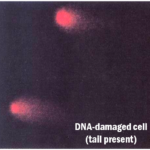
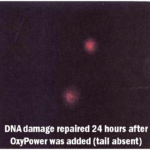
While the herbs in Vein Lite improves blood flow, the herbs in OxyPower may repair damage to cells and blood vessels and increases oxygen supply to cells. Mitochondrial DNA damage increases susceptibility to neurodegenerative diseases like Alzheimer’s disease. These herbs have been shown to repair this damage in the Comet assay. Potassium dichromate was used to induce damage to the cells, evident as the “tail.” Then 24 hours after adding OxyPower, DNA damage was obviously repaired, seen as the absence of the tail (see figures below).
Furthermore, OxyPower is also a powerful antioxidant, so it helps protect cells from damage caused by free radicals. It also reduces C-Reactive Protein and inflammation. This helps in reducing swelling of the arteries and blood vessels that constricts blood flow.
Its antioxidant, anti-inflammatory and anti-hypoxic properties may make OxyPower a very effective cardioprotective supplement, reducing the risk for atherosclerosis, stroke, and heart attacks. Its anti-hypoxic effect, in particular, is useful. The brain uses up to 20% of all the oxygen taken up by the body and affects memory and cognitive function. By regulating oxygen supply to cells, OxyPower may improve memory and brain function.
A case from S. Layton, ND from Texas, demonstrates how the combination of OxyPower and Vein Lite can improve heart function and reduces the risk of poor blood flow to the brain. She has a 60-year-old female patient with elevated BNP (brain natriuretic peptide). BNP is a substance secreted from cardiac ventricles. High levels of BNP indicate severe heart failure. The patient took OxyPower and Vein Lite. After a few months, her BNP reduced from 4500 to 2500.
*The information from this article was shared with us by Chi’s Enterprise. These statements have not been evaluated by the Food & Drug Administration. These products are not intended to diagnose, prevent, treat or cure any diseases.